Among the problems that villa owners may encounter after living in their homes for several years are the appearance of damp spots on the walls, peeling paint, a musty odor in the bathrooms, or high energy consumption by air conditioning units without achieving the desired level of comfort.
Poor or improperly executed insulation can be a primary cause of these issues, alongside other potential factors such as water leaks, inadequate ventilation, and condensation.
Selecting the appropriate insulation system and ensuring its correct installation—starting from the construction phase—is crucial. Once insulation layers are covered and finishing work is complete, identifying and rectifying any defects becomes significantly more difficult and costly.
This article explains the difference between waterproofing and thermal insulation, where each is applied in a villa, common mistakes to avoid, and how to ensure quality before applying the insulation layers. It's a practical guide for anyone looking for... Villa Insulation in Jeddah, whether building a new villa or addressing an issue in an existing one.
Why does villa insulation in Jeddah require special attention?
Jeddah’s coastal location exposes its buildings to environmental conditions that make the selection of an appropriate insulation system crucial—particularly for roofs, facades, and components in contact with the ground.
Among the most prominent factors to consider are:
- Coastal humidity:- Moisture and exposure to salts may affect some building materials and concrete elements, especially when there are defects in the protective layer or concrete cover.
- High temperatures:- The surfaces and facades are exposed to the sun for long periods of time, which makes thermal insulation even more important to reduce the transfer of heat into the villa
- Rainfall:- Open surfaces require an appropriate system for waterproofing and water drainage, so that water accumulations do not cause future leaks
- Variation in soil nature:- The characteristics of the soil and groundwater vary from region to region, so the soil report and design should be consulted when determining the foundation protection system and the walls that contact the soil
Therefore, it is not enough to say that the villa is isolated. What matters is determining the type of insulation, the location where it will be applied, the materials used, the method of application and testing
What is the difference between water insulation and thermal insulation??
The two types serve different purposes; neither of them is redundant to the other. Some parts of the villa may require both systems in accordance with the approved design and specifications
Waterproofing insulation.
Waterproofing aims to prevent water leakage and reduce the ingress of moisture into concrete elements and buildings
It is used in places that are exposed to water or moisture directly, such as surfaces, bathrooms, tanks, foundations, and swimming pools
When the waterproofing system fails, problems such as leaks, paint peeling, the appearance of salts and moisture may appear. Some cases may even lead to damage to the concrete or corrosion of the reinforcement steel depending on the exposure conditions and the condition of the structural element
Thermal insulation.
Thermal insulation aims to reduce the transfer of heat from the external environment to the interior of the building, or vice versa, which helps improve thermal comfort and reduce the load on the air conditioning systems
Its importance is highlighted on exterior surfaces, walls, facades, and roofs exposed to the sun
The presence of thermal insulation does not necessarily mean that the building is protected from water leakage; some thermal insulation materials are affected by moisture and require an appropriate protection system
Comparison between water insulation and thermal insulation.
| Basis of comparison | Waterproofing insulation. | Thermal insulation. |
|---|---|---|
| The goal | Preventing water and moisture leakage | Reducing heat transfer |
| The most prominent places | The surfaces, bathrooms, basements, foundations, and swimming pools | The surfaces, external walls, ceilings and facades |
| Common materials | Bituminous, polymer, cementitious and liquid materials | XPS panels, EPS, polyurethane foam, and rock wool |
| The result of negligence | Leaks, moisture, and damage in building layers | Increased thermal load and poor comfort within the building |
| Timeliness of implementation | Before the protective layers and finishes in areas exposed to water | Within the roof or wall system according to the design and implementation stages |
It is important to note that double glazing and windows with suitable thermal specifications can contribute to improving the performance of the facade, but they are not a substitute for the thermal insulation system for walls and ceilings.
Where is the waterproofing carried out in the villa?
The scope of water insulation varies depending on the design of the villa and the nature of the use of each part of it, but there are key areas that deserve attention.
1. The surface of the villa and the exposed ceiling
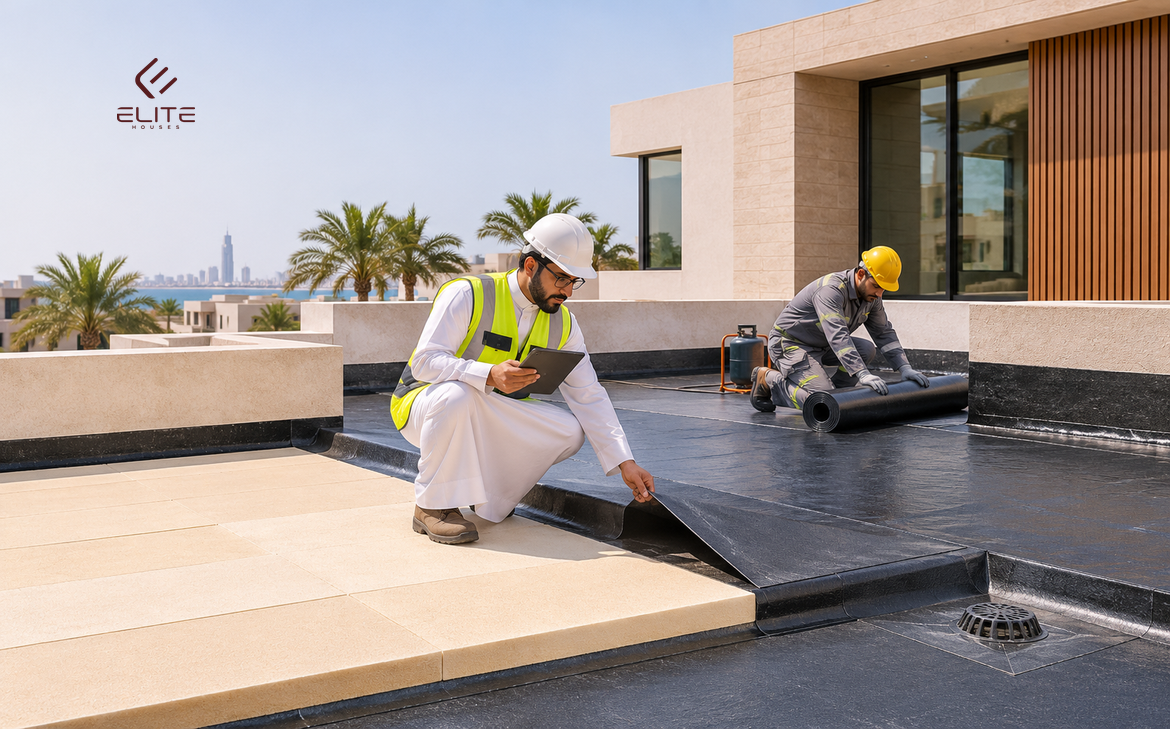
The roof is one of the parts of the villa that is most exposed to sunlight and rain, and therefore needs an appropriate waterproofing system, with attention paid to the details of the installation.
This includes:
- Prepare the surface before applying the insulation material.
- Repairing cracks and gaps according to specifications.
- Implement isolation in a continuous manner as much as possible.
- Treating the intersections of the surface with walls and barriers.
- Attention to the water discharge outlets and around the pipes and openings.
- Protecting the insulation layer after completion of implementation.
The quality of the insulation is not limited to the material used; the small details at the edges and corners can be the most sensitive areas for leakage to occur.
2. Bathrooms and wet areas
Bathrooms, laundry rooms, and areas exposed to water need a suitable insulation system before installing the tiles and final finishes.
And the most important points of implementation are:
- Preparing the floor and removing the weak parts.
- Treatment of angles and gaps between floors and walls.
- Lift the insulation on the walls to the specified height in the specifications.
- Treatment of water and sewage pipe crossing points.
- Test the insulation in the appropriate way before installing the tiles.
These measures help reduce the chances of water seeping into the ceilings or adjacent walls.
3. Ground and overhead tanks
Water tanks require materials and insulation systems designed to withstand continuous use and contact with water.
When choosing the materials for the drinking water tank, it is necessary to ensure that the material is suitable for this use and that documentation of its approval exists in accordance with the relevant requirements.
Attention must also be paid to the details of the gaps, angles, and appropriate tests before operating the tank.
4. Foundations and walls in contact with the ground
The foundations and walls that come into contact with the soil, such as the buttresses and some retaining walls, require a study of the moisture and water protection system based on the soil report, the structural design, and the site conditions.
Protection must be implemented before the demolition or closure of the parts that are difficult to access later; because repairing the insulation in these locations may require excavation and re-installation work.
5. Swimming pools, fountains and basins
If the villa has a swimming pool, fountain, or water basin, a special insulation system must be used for these facilities; this system is responsible for the constant contact with water, operating conditions, and the materials used in water treatment.
No general insulating material should be used without ensuring that it is suitable for this type of use.
Where is the thermal insulation installed in the villa?
Thermal insulation helps reduce heat transfer through the building envelope; its system is determined by design, specifications, and energy efficiency requirements.
And some of the most prominent places that it could cover include:
1. Surfaces
The exposed surfaces are exposed to the sun for long periods of time, so insulating them is an important element to improve the villa's thermal performance.
Thermal insulation panels or polyurethane foam can be used within various systems; their placement is determined according to the approved system regarding the water insulation layer and protective layers.
2. Exterior walls
Heat transfer through walls can be reduced using appropriate insulation systems within the details of the wall or facade, such as thermal insulation panels or building units with insulating properties.
The protection of the insulating material from moisture and damage must be taken into account, and it must be ensured that it complies with the facade system used.
3. Facades and windows
Choosing double glazing and the appropriate frames helps reduce heat transfer through the windows, while still allowing for the benefit of natural light.
The efficiency of the window depends on a range of factors, such as the type of glass, the frame, and the tightness around the openings.
4. The Bishop and the Attachments
Attachments and rooms located on the roofs require special consideration if they are exposed to direct sunlight; thermal insulation can be integrated into the roof and wall system according to the design.
Important point: The arrangement of insulation layers on surfaces affects the efficiency of the system and its lifespan. The method of placing the water and thermal insulation layers and the layers of protection may vary from project to project. Therefore, a clear and approved layering system must be followed, which is consistent with the design and technical specifications of the manufacturer.
The most common insulation installation errors in villas
Good insulation materials may be available, but poor preparation, application, or testing can lead to a weak system performance. The most notable mistakes to avoid are:
1. Confusion between waterproofing and thermal insulation
Some contracts use the word «insulation» only without specifying the type and location. Thermal insulation may be implemented and is believed to prevent water leakage, or vice versa.
The solution: Determine the type, location, material, thickness, and system of layers of insulation clearly in the contract and specifications.
2. Improper surface preparation
Surface preparation is one of the most important steps in ensuring the success of insulation. Dust, oils, weak parts, and cracks and damage must be removed before applying the material.
The requirements for humidity, flatness, and the method of surface preparation vary depending on the type of insulation material and the manufacturer’s instructions; some systems require a dry surface, while other systems require the surface to be moistened before application.
Performing insulation without adhering to the surface preparation requirements may lead to poor adhesion, the appearance of bubbles, or separation of parts of the insulating layer.
The solution: Review the technical documentation for the material used and prepare the surface according to the manufacturer's instructions and the approved specifications.
3. Neglecting the edges, corners, and drainage outlets
The leakage may begin at points where the surface meets the wall, around pipes, or at junctions and gaps, and not necessarily from the center of the surface.
The solution: Attention to the operational details of corners, edges, gaps, and drainage outlets, and the use of appropriate treatments for each system.
4. Failure to implement proper drainage systems
If the surface slopes are inadequate, water may accumulate in certain areas for extended periods, increasing pressure on the waterproofing system and raising the likelihood of problems arising.
The solution: Verify the levels, slopes, and locations of drains in accordance with the design, prior to the installation of the waterproofing and protection layers.
5. Reducing the number of layers or thicknesses
Reducing the quantity of material or the number of layers below the specified requirements may result in poor performance of the insulation system and its inability to withstand operational conditions and exposure.
The solution: Specify the material, thickness, number of layers, and application method in the specifications, and verify that they are actually implemented.
6. Covering the insulation before testing it
Protective layers or flooring may be installed before verifying the integrity of the waterproofing layer. If a leak subsequently appears, identifying the source of the problem—and addressing it—becomes far more difficult and costly.
The solution: Conduct the appropriate test for the type and location of the insulation before it is covered—such as a water-ponding (immersion) test for roofs or other areas where specifications permit—while documenting the results and adhering to the required test duration and methodology as per the technical specifications and the manufacturer’s instructions.
7. Use of materials unsuitable for the location
A material suitable for waterproofing an exposed surface may not be appropriate for a water tank or a swimming pool that is subject to constant submersion.
The solution: Select the material based on the nature of its use and the conditions to which it will be exposed, and verify the relevant technical data sheets and certifications.
8. Failure to protect the insulation during subsequent work
Plumbing, electrical work, tile installation, and the moving of equipment can cause the insulation layer to be scratched or punctured after it has been applied.
The solution: Implementing appropriate protective layers, organizing the movement of workers and subsequent operations, and inspecting the layer before it is finally covered.
9. Postponing insulation planning until the finishing stage
Delayed planning makes it difficult to implement certain systems—particularly those involving foundations, tanks, and components that will subsequently be covered by backfill, concrete, or finishes.
The solution: Defining insulation requirements from the planning stage, and implementing each system at the appropriate time during the construction phases.
10. Absence of a guarantee and documentation
Determining a contractor’s liability or demanding remedial action when a problem arises can be difficult if the materials, workmanship, and tests are not documented.
The solution: Retain invoices for materials, technical data sheets, test reports, and photographs, and obtain a written warranty that clearly specifies its duration, scope, and exclusions.
Signs indicating a problem with insulation
Certain signs may appear that necessitate an inspection of the insulation system or an investigation into the source of moisture and leaks; among the most notable are:
- Dark spots or yellowing on the ceilings or walls of the top floor.
- Peeling or blistering of paint, especially in the corners.
- A musty or damp odor in bathrooms and enclosed rooms.
- The appearance of white salts on walls, a phenomenon known as efflorescence.
- The presence of leaks or traces of water beneath bathrooms or near tanks.
- Increased electricity consumption, accompanied by noticeable heat in the upper rooms, is a sign that warrants an assessment of the building's thermal performance.
- Water collects on the surface after rainfall.
These signs do not necessarily mean that the insulation is the sole cause of the problem. There could be plumbing leaks, ventilation issues, condensation, or other contributing factors.
Therefore, it is advisable to conduct an on-site inspection to identify the source of the problem before beginning any painting or restoration work, as addressing only the external appearance does not resolve the underlying cause.
When is the most appropriate time to carry out waterproofing?
Planning for insulation begins at the design stage, while each system is implemented during its appropriate phase of construction.
For example, foundation protection systems are implemented before backfilling; waterproofing for bathrooms is applied prior to the installation of tiles; and roof waterproofing is carried out once the preceding work is complete and the surface has been prepared in accordance with the approved system.
As for thermal insulation, it is incorporated into the details of the roof, walls, and facades during the stages specified in the plans.
And if you are about to receive the villa's structure, you can benefit from our guide on Inspection of a Villa’s Structural Shell in Jeddah: A Checklist Before Starting Finishes To review the work completed prior to the finishing stages and ensure that no provisions related to waterproofing/insulation have been overlooked.
You can also read a guide Structural construction contractor in Jeddah To understand the scope of the structural work and the contractor's responsibilities before moving on to the subsequent stages.
For existing villas, the appropriate solution depends on the condition of the building. Some cases may require localized repairs, re-waterproofing of the roof, treatment of bathrooms and water tanks, or the implementation of a new protection system. The specific solution must be determined following an inspection to identify the root cause of the problem.
A list of questions to ask an insulation contractor before hiring them
Before reaching an agreement with an insulation contractor, it is important not to limit your inquiries to the price or the name of the material being used. Ask the following questions:
- What type of waterproofing is proposed for each location: the roof, bathrooms, tanks, and foundations?
- What materials are used? And are there technical data sheets available that explain their properties and application methods?
- What is the number of layers and thicknesses specified in the specifications?
- How will the surface be prepared before the material is applied?
- What test will be conducted to verify the integrity of the insulation before it is covered?
- Who is responsible for protecting the insulation layer during the execution of subsequent works?
- Does the contract include the treatment of joints, edges, and drainage outlets?
- What is the duration of the warranty? And what types of work and defects does it cover?
- Will the materials, tests, and implementation stages be documented?
- When will the insulation work be carried out within the project schedule?
These questions help you compare contractors' proposals more accurately, rather than relying solely on price.
Technical Requirements for Thermal Insulation in Villas According to the Saudi Building Code
Thermal insulation is linked to energy efficiency requirements in buildings; the Saudi Building Code for Energy Conservation in Residential Buildings (SBC 602) serves as a primary reference for low-rise residential buildings, defined as those comprising three stories or fewer.
The code addresses requirements for the building envelope, air conditioning and ventilation systems, water heating, indoor air quality, lighting, and other energy-efficiency elements.
The requirements for the construction of residential buildings also include specifications for waterproofing and thermal insulation of roofs, as well as the treatment of external walls, in accordance with relevant codes.
You may refer to the following official sources:
- Saudi Building Code Center – Saudi Energy Conservation Code for Residential Buildings (SBC 602).
- Ministry of Municipalities and Housing – Requirements for the Construction of Residential Buildings.
It is important that the insulation system be selected and implemented in accordance with the project requirements, plans, and approved specifications, rather than relying on a single type of material or a uniform thickness for all the villas.
How do you choose the right contractor for waterproofing work in a construction project?
Coordinating insulation work with the various stages of construction is important to ensure it does not conflict with plumbing, electrical, or finishing work.
When selecting the contractor for the project, ensure that the scope of the insulation work is clearly defined in the contract. This should include the types of materials to be used, the locations for application, the required thicknesses, the testing methodology, and the responsibility for protecting the insulation layers during the execution of subsequent construction phases.
Elite Houses provides services for the execution of residential and commercial projects in Jeddah, in addition to finishing, maintenance, and renovation work.
You can take a look at Elite Houses Services and identifying The company’s residential and commercial projects, or Contacting the company team To discuss your project requirements and the appropriate scope of implementation.
Frequently Asked Questions About Villa Insulation in Jeddah
Does waterproofing eliminate the need for thermal insulation?
No. Waterproofing prevents the ingress of water and moisture, whereas thermal insulation reduces heat transfer. Each type serves a different purpose, and a villa may require both systems, depending on the design requirements for specific areas.
What are the most important areas in a villa that need to be insulated?
Key areas include exposed surfaces, bathroom and wet-area flooring, water tanks, components in contact with the soil, and swimming pools (if present). The scope of waterproofing varies depending on the villa’s design and site conditions.
Is it possible to insulate the villa after construction is complete?
Yes, waterproofing can be applied or reapplied in certain areas—such as roofs and bathrooms—even after construction is complete; however, this may require removing and subsequently restoring some finishes. As for foundations and other components that are buried or enclosed, addressing them can be significantly more difficult and costly.
How long does waterproofing last?
The performance lifespan of insulation varies depending on the type of material, the quality of preparation and installation, exposure conditions, and maintenance. Therefore, one should not rely on a single, uniform duration for all systems; instead, the technical data sheet and the terms of the written warranty should be consulted.
Does thermal insulation reduce the electricity bill?
Thermal insulation helps reduce heat transfer into a building, which can, in turn, lower the load on air conditioning systems and decrease their energy consumption. However, the extent of these savings varies depending on the villa’s design, the surface area of its windows, the type of glass used, the quality of the ventilation and air conditioning systems, and the specific insulation method employed.
Should the waterproofing be tested before installing tiles or protective layers?
Yes, appropriate testing of the system in use should be conducted before it is covered—such as a water immersion test, where specifications permit—with the results documented and the integrity of the waterproofing layer verified.
Can the same material be used to waterproof both the roof and the tank?
Not necessarily. A material suitable for an exposed surface might not be appropriate for a water tank or a swimming pool. The waterproofing system must be selected based on the intended application and exposure conditions, ensuring it is fit for the required purpose.
Conclusion
Villa waterproofing in Jeddah is not merely a clause to be written into a contract and then forgotten; rather, it is a comprehensive process that begins with planning and the selection of appropriate materials. It extends to surface preparation, the application of waterproofing layers, the treatment of joints and corners, and finally, testing and protecting the waterproofing system before it is covered by the finishing layers.
Distinguishing between waterproofing and thermal insulation remains a fundamental step; the former protects the building against water leakage and moisture, while the latter helps reduce heat transfer and improve comfort within the villa.
Once insulation requirements are clearly defined, the appropriate system for each location is selected, and the quality of installation is verified before it is covered up, it becomes much easier to avoid issues that might otherwise necessitate costly repairs later on.
Are you planning to build a villa in Jeddah? Take a look at Project Execution Services at Elite Houses, or Get in touch with the company team To discuss your project requirements and the implementation phases.