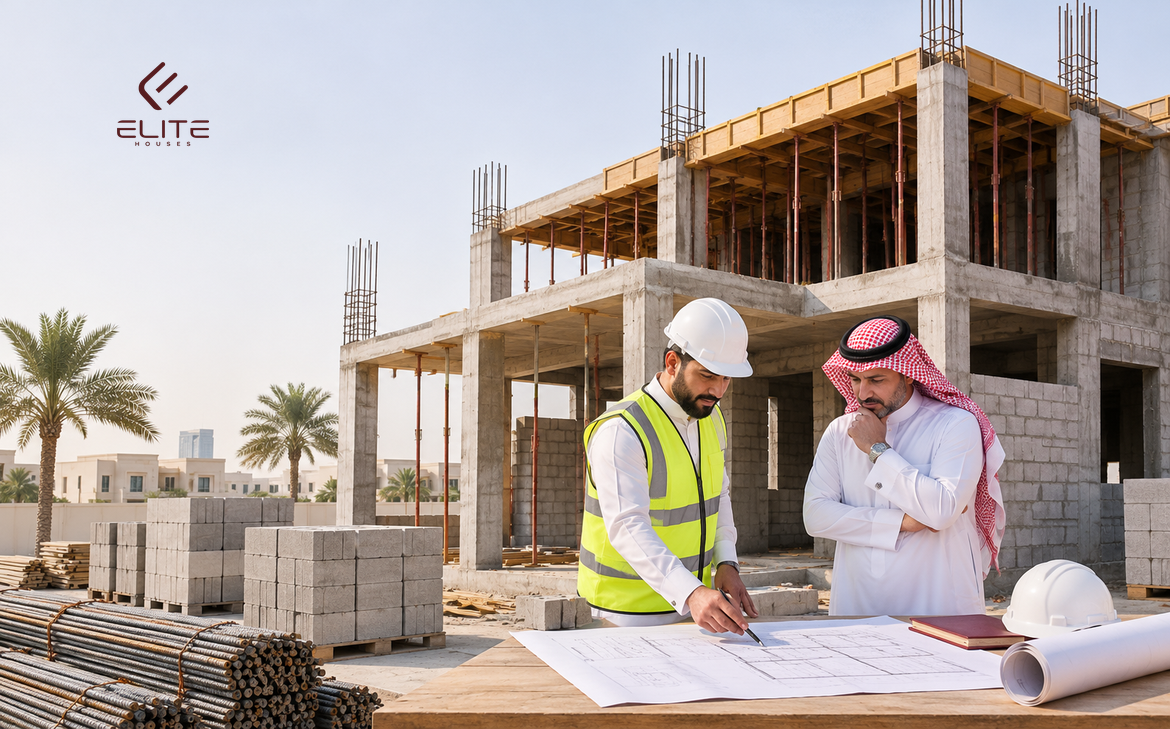
When planning to build a villa, the first question is usually: how much will it cost? Cost of constructing the structural shell of a villaThe straightforward answer is that there is no single figure that applies to all projects; the cost varies based on the building area, the number of floors, the design of the structural plans, the nature of the soil, the quality of materials, and the contracting method.
Some contractor bids include excavation, foundations, and blockwork, while others are limited to the concrete structure only. This discrepancy can make one bid appear less expensive than another, even though the scope of work is not identical.
In this article, we explain what is included in the structural construction phase (the "skeleton" of a building), how its cost is calculated, the factors that can increase or decrease that cost, the difference between contracts that include materials versus those covering labor only, and how to fairly compare price quotes before signing any contract.
What is meant by bone building, and what does it typically entail?
The structural phase—often referred to as "building the skeleton"—is the stage in which the primary framework of a structure is constructed, prior to finishing works. It encompasses the structural elements that enable the building to support loads and serve as the foundation for subsequent construction phases.
Among the tasks that may fall within the scope of a structural-only (skeleton) contract are:
- Excavation and foundation works: Excavation, site preparation, and the construction of footings or the foundation raft and grade beams, in accordance with the plans.
- Columns: Construction of the vertical elements that transfer loads to the foundations.
- Beams and Girders: Structural elements that connect the parts of a structure and transfer loads.
- Concrete Slabs and Ceilings: Execution of ceilings and horizontal elements in accordance with the design.
- Concrete Stairs: Construction of the staircase and its associated elements.
- Building works: Construction of external and internal walls using blocks, if included in the contract.
However, the scope of "skeleton" (structural) construction varies from one contract to another. Some contractors include excavation, backfilling, water tank construction, waterproofing, or the installation of electrical and plumbing infrastructure, while others leave these tasks for separate phases.
Therefore, the first step before comparing prices is to obtain A written and detailed scope of work It specifies the items included and excluded.
If you would like to know what should be checked once this stage is complete, you can refer to our guide on Inspection of a Villa’s Structural Shell in Jeddah: A Checklist Before Starting Finishes.
How is the cost of the structural shell (skeleton) calculated?
There are two common methods for pricing structural (shell-and-core) construction work, each with a different application:
1. Pricing per square meter (cost per square meter for the structural shell in Jeddah)
The cost is calculated by multiplying the total construction area by the agreed-upon price per meter.
Cost of the structural shell = Total built-up area × Price per square meter
It is a quick method suitable for preliminary estimation and for comparing initial offers.
But they may hide important details, such as the amount of iron and concrete, the type of foundation, the roofing system, excavation and backfilling, and additional items.
It is also necessary to verify how the area is calculated; typically, this refers to the total built-up area of the floors included in the contract, rather than the land area alone.
2. Pricing based on the Bill of Quantities
In this method, the quantities of work and materials required are determined based on architectural and structural drawings, and each item is then priced individually.
The bill of quantities may include:
- Excavation and backfilling.
- Quantities of plain and reinforced concrete.
- Reinforcing steel.
- Formwork and molds.
- Blockwork and masonry.
- Stairs and additional concrete elements.
- Equipment, transportation, and testing, as per the scope of the contract.
This approach is more detailed and clear when entering into a contract, as it facilitates a line-by-line comparison of offers and reduces disputes in the event that quantities change or additional work arises.
advice: The price per square meter can be used for an initial estimate; however, when it comes to the actual contract, it is preferable that the contractor’s proposal be based on a clear bill of quantities and specifications.
Factors that determine the cost of the structural construction (shell) of a villa
The cost of two villas with similar built-up areas can vary significantly due to differences in structural design, site conditions, and the scope of work.
Among the most influential factors are:
1. Building area and number of floors
As the total built-up area increases, the quantities of concrete, steel, blocks, and labor required typically increase as well.
The number of stories and their heights also influence the construction method, the quantities of structural elements, the formwork, and the equipment used.
An equal built-up area does not necessarily mean an equal cost; the quantities of materials required for two villas may differ due to variations in their design.
2. Soil condition and foundation depth
The results of the soil investigation report influence the determination of the foundation system and the required construction methods.
The project may require individual footings, a raft foundation, or another foundation system, depending on the approved structural design.
Some sites may also require additional work, such as:
- Removal of unsuitable soil.
- Replacement and compaction.
- Drilling to greater depths.
- Drain the water when necessary.
- Reinforcing the sides of an excavation under certain conditions.
These tasks may lead to higher costs compared to a site that does not require them.
Therefore, the cost of the foundations should not be finalized before reviewing the soil report and the structural drawings.
3. Complexity of structural drawings
The nature of the design affects the cost of constructing the structural framework.
Some designs may require:
- Vast creative expanses.
- Beams or ceilings with special details.
- Architectural projections and cantilevers.
- Large structural openings.
- Multi-level ceilings.
- Concrete elements with unconventional shapes.
These details may increase the quantities of reinforcement, concrete, formwork, and shuttering, depending on the approved design.
4. Quality and type of materials
The price is influenced by the quality of the materials and their technical specifications, particularly:
- Reinforcing steel.
- Ready-mix concrete.
- Cement.
- The block.
- Formwork and shuttering materials.
- Other materials falling within the scope of the contract.
The specifications and grades of the materials must be defined in the agreement; relying on general terms such as "excellent materials" or "good-quality steel" is not sufficient.
5. Material prices at the time of execution
The prices of steel, cement, concrete, and labor change over time; therefore, one cannot rely on an old price quote for a project that is set to begin well into the future.
The General Authority for Statistics publishes monthly data on the average prices of certain construction commodities, as well as a construction cost index that tracks price fluctuations for materials, labor, equipment, energy, and services related to construction.
The General Authority for Statistics publishes monthly data on the average prices of certain construction commodities, as well as a construction cost index that tracks price fluctuations for materials, labor, equipment, energy, and services related to construction.
6. Location of the land and ease of access to it
The nature of the site may affect the costs of transportation, supply, and execution.
Plots located on narrow streets, or sites where access for concrete mixers, pumps, and other equipment is difficult, may require additional arrangements.
The distance between the supplier and the site, as well as the available storage space, also influence the organization of supply operations.
7. Implementation duration and team size
Reducing the execution duration may require increasing the number of workers or pieces of equipment, or organizing work shifts differently.
However, accelerating execution should not come at the expense of the quality of the work, the necessary inspections, or the time required for concrete curing and the completion of project phases in accordance with specifications.
8. Inspections and Quality Tests
It is important to determine whether the contractor’s proposal includes the required tests and inspections for materials and work, or if these are a separate item to be covered by the owner.
Depending on the project requirements, the tests may include:
- Concrete tests.
- Inspection of reinforcing steel when necessary.
- Soil and compaction testing for related works.
- Testing of other materials in accordance with approved specifications.
The agreement must specify who is responsible for providing the tests, covering their costs, and documenting their results.
The cost of the structural shell (skeleton) with and without materials: What is the difference, and which option is right for you?
One of the most common reasons for discrepancies between price quotes is that one may include both materials and labor, while another covers only labor; consequently, the second quote appears less expensive, even though it does not include the cost of materials.
Structural works (including materials and labor)
In this model, the contractor is responsible for providing materials and labor, and for executing the agreed-upon works.
The materials may include:
- Reinforcing steel.
- Ready-mix concrete.
- The block.
- Cement.
- Materials for formwork and molds shall be as agreed upon.
- Other implementation requirements.
Among the advantages of this model are:
- Reducing the daily burdens associated with purchasing supplies.
- Having a single entity responsible for both supply and execution within the scope of the contract.
- Ease of establishing a contractual budget when quantities and specifications are defined.
- Reducing the owner's need to continuously monitor procurement and supply operations.
It is essential to ensure that material specifications are included in the contract, covering the type of steel, concrete strength, type of masonry blocks, quantities, and the procedure for approving alternatives.
Structural work (shell/skeleton) only, including labor costs.
In this model, the owner provides the materials, while the contractor supplies the labor and carries out the work in exchange for an agreed-upon fee.
Among the advantages of this model are:
- Greater control for the owner in selecting material suppliers.
- The ability to compare material prices from multiple suppliers.
- Real-time monitoring of purchases and quantities.
- Greater flexibility in the selection of materials and their specifications.
However, this model requires greater oversight from the owner or their representative, as delays in the supply of materials, shortages in quantities, or improper storage could impact the project schedule and final cost.
A comparison between the two systems
| Basis of comparison | Materials and workmanship | For labor costs only |
|---|---|---|
| Provision of steel and concrete | The Contractor under the Contract | The owner, most likely |
| Supply of blocks and cement | The Contractor under the Contract | The owner, most likely |
| Labor wages | As part of the contractor's proposal | Included in the contractor's fees |
| Tracking Purchases | Within the scope of the contractor’s agreed-upon responsibilities | The owner bears a larger share of it. |
| Controlling the selection of suppliers | In accordance with the terms of the contract | Greater for the owner |
| Budget monitoring | A more comprehensive, unified view | You need to monitor both the materials and the workmanship. |
| Responsibility for implementation | The contractor, within their scope | The contractor, within their scope |
The choice between the two methods depends on your experience and your ability to monitor the site and manage purchases. In both cases, it is necessary to determine who bears responsibility for transporting and storing materials, waste, and delayed supply, so that these details do not turn into disputes during implementation.
What might not be included in the price of the bone?
Many financial surprises arise from items that were not mentioned in the price quote, or for which it was not clearly specified whether they were included or excluded.
Ask about the following terms before signing the contract:
- The outer perimeter wall and the gates.
- The ground-level and elevated tanks.
- Septic tank and external drainage works.
- External annex or driver's room.
- The elevator pit and its associated equipment.
- Waterproofing and thermal insulation work.
- Installation of electrical, plumbing, and HVAC systems.
- Soil and concrete examinations and quality tests.
- Transporting waste and equipment, and preparing the site.
- Government fees, licenses, design, and engineering supervision.
- Value-added tax, if not included in the total price.
Some of these items may be included in one contractor’s bid, while being excluded from another’s.
You can also take a look at The difference between full finishing and semi-finishing To understand where the structural (shell) work ends and what transitions to the finishing phase, according to the scope of the contract.
What is the price per square meter for the structural shell (skeleton) of a building in Jeddah?
There is no single, official price per square meter for structural construction (the "skeleton" phase) in Jeddah; published rates vary depending on the calculation method, the scope of work, and the materials included in the offer.
Some estimates published during 2026 show the following indicators:
| Type of assessment | Published indicative price |
|---|---|
| Structural construction (shell and core) including materials, based on one of the Jeddah-specific calculators. | 509–742 SAR/m² |
| Construction (skeleton/structural frame only) without materials, according to one of the Jeddah-based cost calculators. | 127–244 SAR/m² |
| Structural construction (shell and core) based on the latest price guide | 650–950 SAR/m² |
| Labor charges only, in accordance with the same manual. | 140–250 SAR/m² |
These figures do not constitute an official market average, nor do they represent pricing authorized by Elite Houses. كما لا يجوز اعتبارها عروضًا متطابقة؛ لأن تعريف نطاق العظم والبنود المشمولة قد يختلف من مصدر إلى آخر.
There is also information published in Jeddah that presents a higher price range for "skeleton" (structural shell) construction—reaching 1,000–1,400 SAR per square meter—which includes excavation, foundations, the concrete structure, and masonry work. This discrepancy illustrates why the scope of work must be examined before relying on any published figure.
Therefore, we recommend using these estimates for preliminary guidance only, and subsequently requesting an updated price quote based on the actual plans, the bill of quantities, and the project site.
You can also follow Average prices of goods and services according to the General Authority for Statistics, andConstruction Cost Index To understand trends in construction material prices and building costs.
A calculation example for the structural construction cost of a villa
Suppose you are planning to build a villa with a total built-up area of 400 square meters, and you have received a hypothetical quote of 700 riyals per square meter.
The initial cost can be calculated as follows:
400 square meters × 700 riyals = 280,000 riyals.
If the hypothetical offer price differs, the results will be as follows:
| Default price per meter | Built-up area | Computational cost |
|---|---|---|
| 600 SAR | 400 m² | 240,000 Riyals |
| 700 SAR | 400 m² | 280,000 Riyals |
| 800 SAR | 400 m² | 320,000 Riyals |
These are illustrative calculations to demonstrate the method; they are neither recommended prices nor actual offers from contractors.
Subsequently, it is necessary to review the excluded items, applicable fees and taxes, and any additional work not covered by the per-meter price.
note: If a plot of land measures 300 square meters and a villa built upon it consists of two floors, this does not mean the total built-up area is 300 square meters; rather, the total floor area—as defined by the agreed-upon method of measurement—must be calculated.
How can you make a fair comparison between structural construction quotes?
Before choosing the cheapest bid, ensure that all contractors are pricing the same work and the same specifications.
Follow these steps:
1. Standardizing the scope of work
Ensure that all proposals include the same line items—such as excavation, foundations, concrete, columns, roofing, and masonry work—and identify any additional or excluded items.
2. Approval of the same plans
Send the latest certified copy of the architectural and construction plans to all contractors, so that pricing assumptions do not differ from one offer to another.
3. Review of material specifications
Determine the type of iron, concrete resistance, block type and thickness, and any other technical specifications related to the project.
4. Standardizing the pricing method
Does the contractor base their pricing on the square meter or on a bill of quantities? Furthermore, how are stairs, annexes, projections (overhangs), boundary walls, and water tanks calculated?
The measurement method must be specified in writing before the proposal is approved.
5. Determining Responsibility for Materials
Regarding the structural phase and materials, refer to the contractor’s responsibility concerning procurement, specifications, and waste.
Regarding the structural phase (shell construction) on a labor-only basis, ensure that the owner is responsible for purchasing, transporting, and storing materials, as well as ensuring their timely availability.
6. Review of examinations and tests
Ensure that the required tests are identified, the party responsible for conducting them is specified, their costs are determined, and the results are documented.
7. Reviewing the payment schedule
It is preferable for payments to be linked to actual, verifiable milestones, rather than relying solely on timelines.
8. Clarification of Duration and Warranty
Specify the duration of execution, the mechanism for handling delays and additional work, and the contractual guarantees and obligations applicable to the project.
To learn more about the criteria for selecting a contractor, read our guide on Structural Construction Contractor in Jeddah: How to Choose the Right Contractor and What Should the Contract Include?.
Mistakes that increase the cost of the structural phase during construction
There are errors that can cause the budget to exceed the initial estimate, even when the quoted price appears reasonable.
Among the most prominent of these are:
- Choosing the cheapest offer without a clear scope: A low price may later turn into additional, unanticipated costs.
- Modifying plans after implementation has begun: Modifications made after the concrete has been poured may necessitate redoing some of the work and incurring additional costs.
- Failure to document changes in writing: Any addition or modification must be agreed upon and approved prior to implementation.
- Ignoring material specifications: Relying solely on the phrase "good materials" opens the door to disputes regarding type and quality.
- Failure to review quantities: Differences in the method used to measure surface area or the quantities of excavation and fill can lead to significant discrepancies.
- Poor coordination between stages of work: Delays in materials, equipment, or labor can lead to an extended project duration and increased costs.
- Postponing examinations: Discovering defects after the execution phase is complete makes them more difficult and costly to address.
It is best to review the work and document observations during the execution phase, rather than only after the structure is complete.
You can also check out our guide on Ten-Year Liability in Saudi Arabia To gain insight into certain aspects related to liability and statutory guarantees.
How does Elite Houses help you carry out your project?
Elite Houses provides project execution services for residential and commercial developments in Jeddah, encompassing building construction, interior and exterior finishing, as well as maintenance and renovation services.
When planning a villa construction project, it is important to define the scope of work, specifications, project phases, and contractual obligations before beginning; this ensures the budget is clear and allows for the monitoring of progress in accordance with the project requirements.
You can take a look at Elite Houses Services and identifying The company’s residential and commercial projects To review samples of published work.
If you are planning to build a villa in Jeddah, you can Contact the Elite Houses team To discuss project requirements and the appropriate scope of implementation, and to obtain an estimate based on your actual plans and specifications.
Frequently Asked Questions About the Cost of Constructing a Villa’s Structural Shell
What is the cost of constructing the structural shell (skeleton) of a villa in Jeddah?
The cost varies depending on the building area, structural design, soil conditions, foundations, type of materials, and the scope of the contract. While market-published prices can serve as preliminary indicators, determining the actual cost requires a review of the blueprints and the bill of quantities.
What is the price per square meter for structural construction (shell and core), including materials, in Jeddah?
Published estimates vary depending on the scope of work and specifications. Some calculators indicate a range of 509 to 742 riyals per meter, while other guides show higher prices. Therefore, it is essential to review the items included in each quote before making a comparison.
What is the price per meter for the structural phase (skeleton/shell), including labor costs only?
Some estimates published in Jeddah indicate a range of 127 to 244 riyals per square meter; however, execution costs may vary based on the number of floors, the complexity of the design, and the equipment and labor required. It is essential to verify the specific items included in the agreement before finalizing the price.
What is the difference between a "skeleton-only" contract (covering materials and labor) and a "labor-only" contract (covering labor only)?
In a "materials-included" structural construction contract, the contractor is responsible for providing the materials and executing the work in accordance with the contract; conversely, in a "labor-only" contract, the owner provides the materials, while the contractor supplies the labor and carries out the construction in exchange for an agreed-upon fee.
Does the price for the structural shell include excavation and foundation work?
Not always. Some contractor proposals include excavation, backfilling, footings, and foundations, while others begin at different stages. You should review the scope of work and the bill of quantities before signing.
Does the bone structure phase include blockwork?
It depends on the contract. The structural phase may encompass both the concrete framework and masonry or blockwork, whereas some contracts are limited to the structural framework only.
Does the cost of the structural shell include the rough-in for electrical and plumbing?
Not necessarily. While certain preparations or openings related to utility installations might be carried out within a specific scope, electrical and plumbing infrastructure work is often defined as separate line items. The scope of such work must be explicitly agreed upon.
Does the land area determine the cost of the structural construction?
No. The calculation is based on the total built-up area covered by the contract, not merely the land area. Therefore, the method for calculating floors, annexes, staircases, and projections must be specified in the agreement.
How can I get an accurate estimate for the cost of structural construction?
The estimation process requires the total built-up area, architectural and structural drawings, and a soil report (if available). It also necessitates clarifying whether the agreement covers both materials and labor or labor only, followed by the preparation of a bill of quantities and a clear scope of work.
Can the cost change after the contract is signed?
Changes may arise when modifications to plans are requested, work outside the scope of the contract is added, or unforeseen site conditions are encountered. Therefore, the contract must include a written mechanism for approving such changes and determining their costs prior to implementation.
Conclusion
The cost of constructing the structural shell of a villa in Jeddah depends on several factors, most notably the total built-up area, soil conditions, structural design, the quantities of steel and concrete required, and whether the contract includes materials or covers labor only.
Relying solely on the price per square meter of construction is not enough to obtain an accurate estimate, as the scope of work, specifications, and excluded items can vary significantly from one contractor to another.
Begin by reviewing the blueprints and the soil report, then define the scope of work to be included in the structural contract, and obtain price quotes based on a standardized bill of quantities and specifications.
If you are planning to build a villa in Jeddah, you can check out Elite Houses Services and identifying Company Projects, or Contact the Elite Houses team To discuss your project requirements and the appropriate scope of implementation.