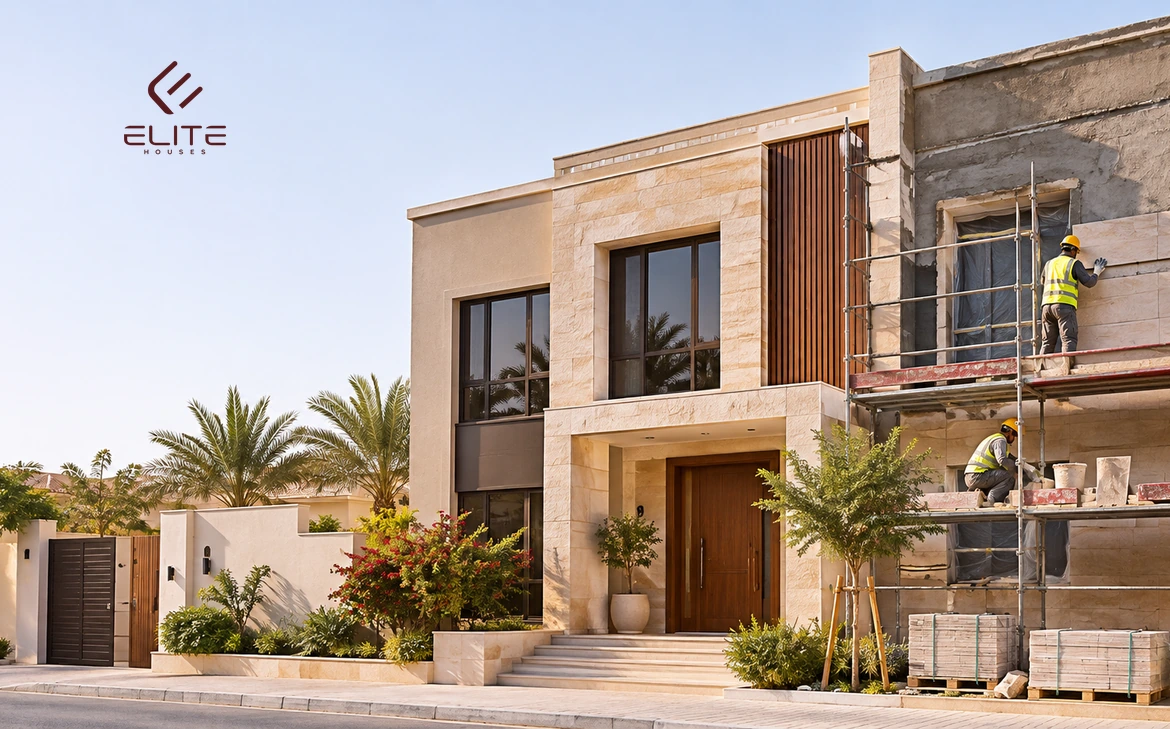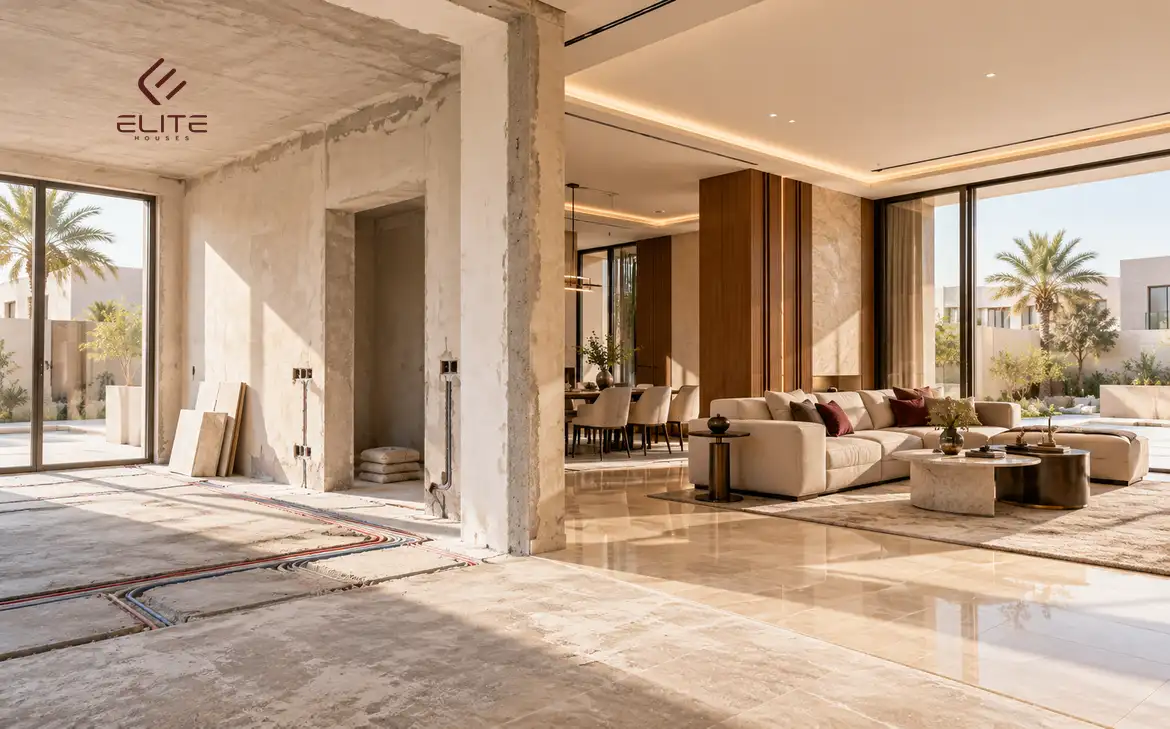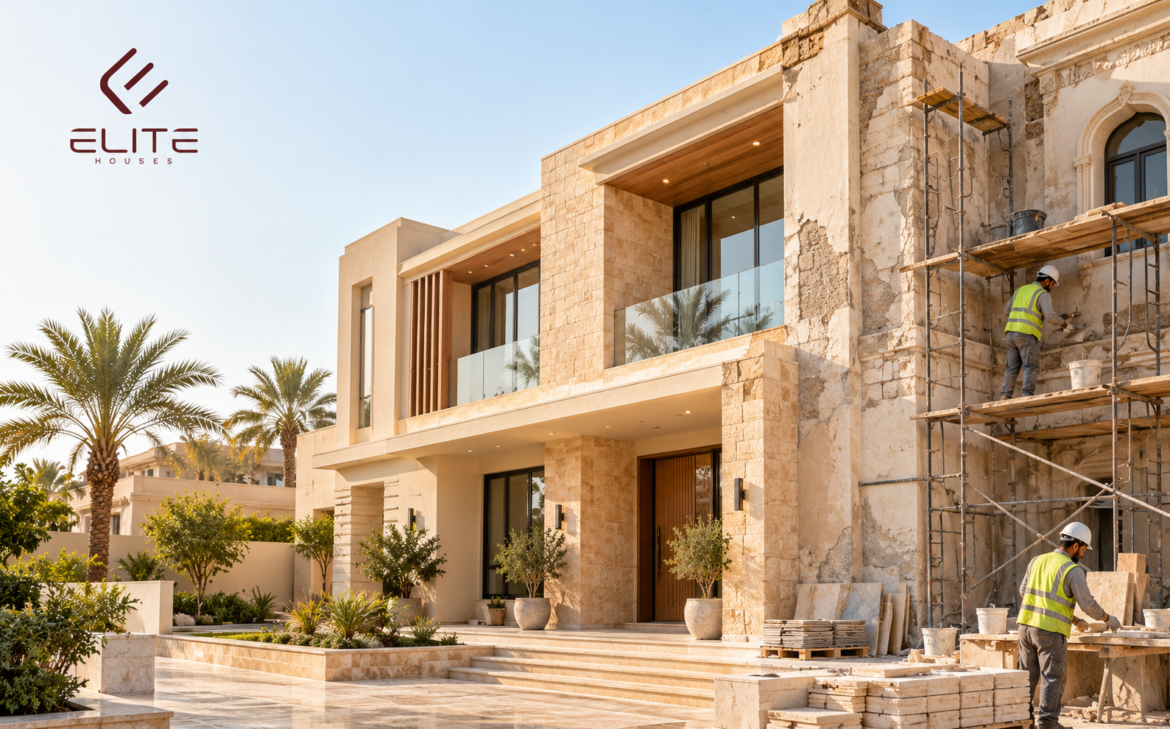
There is no fixed cost for renovating an old villa in Jeddah; the price depends on the building's structural condition, the scope of work, the type of materials used, and whether the project is limited to refreshing the finishes or includes replacing utility systems, installing insulation, and addressing structural defects.
In general, restoration is an option worth considering when the structural framework remains sound and the building can be renovated without radical changes. However, if extensive structural defects are present or the project requires significant redesign, the cost of restoration may approach—or even exceed—the cost of demolition and reconstruction.
In this guide, we explain the cost of villa renovation based on the scope of work, the factors that influence the budget, when renovation is a better choice than demolition, and how to compare the two options before making a decision.
How much does it cost to renovate a villa in Jeddah?
The costs for villa renovation vary depending on the scope of work and the quality of materials and finishes. For initial planning purposes, one may refer to the following published estimates—calculated per square meter of the home’s floor area—based on a price calculator released by the "Muqawala" (Contracting) platform in September 2026.
| Type of restoration | Estimated cost per square meter |
|---|---|
| Cosmetic restoration: paints and surface treatments | 110–140 riyals |
| Partial renovation: Refurbishing certain finishes and installations | 255–325 SAR |
| Comprehensive renovation: partial demolition, renewal of finishes, plumbing, and electrical systems | 475–605 riyals |
| Excellent, comprehensive restoration using top-tier materials | 775–985 riyals |
| Redesign with extensive architectural changes | 1,185–1,510 riyals |
important: These are indicative price ranges for the Saudi market; they do not represent an official statistical average for the city of Jeddah, nor do they constitute a price quote from Elite Houses. Actual costs may vary from these estimates depending on the condition of the property, the scope of work, the method used to calculate the area, the quality of materials, and the specific tasks included in the contract.
Furthermore, extensive redesign differs from traditional restoration; therefore, its cost should not be directly compared to the price of cosmetic or partial restoration.
Can be reviewed Cost estimates for home or villa renovation via the Muqawala platform, published on September 28, 2026.
As for the actual budget for your project, it will be determined following an inspection of the building, an assessment of the required work, and the preparation of a detailed bill of quantities.
Calculation example: Cost of renovating a 300-square-meter villa
Let’s assume you have a villa with a built-up area of 300 square meters, and you want to establish a preliminary budget before requesting price quotes.
| Scope of Work | Approximate computational cost |
|---|---|
| Aesthetic restoration | 33,000–42,000 SAR |
| Partial restoration | 76,500–97,500 SAR |
| Comprehensive restoration | 142,500–181,500 SAR |
| Excellent comprehensive restoration | 232,500–295,500 SAR |
| Extensive redesign | 355,500–453,000 SAR |
These amounts were calculated by multiplying a hypothetical area of 300 square meters by the aforementioned price ranges. They serve as illustrative examples for planning purposes and do not constitute actual price quotes or a guarantee of the final cost.
Furthermore, this example does not imply that every 300-square-meter villa will require these specific amounts; the work might be limited to certain parts of the building, or structural defects could emerge that necessitate an entirely different budget.
The estimates do not necessarily include fees for design, inspections, permits, demolition, or debris removal, unless these items are explicitly included in the approved price quote.
What factors determine the cost of renovating an old villa in Jeddah?
Knowing the area of a villa is not enough to determine the cost of renovation. Several factors influence the final budget.
1. Condition of the structural framework
The structural framework is the most critical element to assess before defining the scope of work. Issues such as cracks, signs of moisture, corrosion of steel reinforcement, or settlement in certain structural components may arise; the cost of remediation varies depending on the underlying cause and the extent of the damage.
In Jeddah, humidity, salts, and coastal environmental conditions can accelerate the corrosion of reinforcing steel when the right conditions are present. Therefore, any signs of damage to the concrete or steel necessitate a structural inspection before a budget is approved.
Begin with an engineering assessment whenever there are signs of structural defects; do not rely solely on an evaluation of the finishing works.
2. Electrical and Plumbing Installations
Older villas may require the replacement of parts of their electrical, plumbing, and sewage systems, especially if the installations are aged or if frequent leaks have occurred.
Furthermore, some issues may only become apparent once walls or ceilings are opened, which could alter the initial cost estimate. It is therefore advisable to assess the condition of the utility lines as thoroughly as possible before signing the contract, and to establish a written mechanism for pricing any additional work should new defects be discovered.
3. Waterproofing and Thermal Insulation
Roofs, bathrooms, and facades may require the repair of leaks or the renewal of waterproofing layers. The root cause of the problem must be addressed before applying new finishes to ensure that the damage does not recur after the project is completed.
The cost varies depending on the area requiring insulation, the condition of the existing layers, the type of system used, and whether it is necessary to remove previous materials or repair damaged sections.
4. Facades and Finishes
The cost varies depending on the materials used for flooring, paints, doors, windows, and exterior cladding, as well as the level of finishing required.
An economical renovation is different from redesigning a villa with high-quality materials and bespoke architectural details. Therefore, the desired level of finish must be clearly specified when requesting price quotes.
5. Changing the interior design
Reconfiguring rooms, kitchens, or bathrooms may require demolition and new construction work, as well as additional installations and finishing touches.
If the modifications involve structural elements or the addition of floor area, you must consult a licensed engineering firm to determine what is technically feasible and to identify the necessary procedures and permits.
6. Removal of debris and additional works
Depending on the nature of the project and the contract, the budget may include the removal of old finishes and the disposal of debris, the protection of areas that will remain unaffected by the work, as well as inspection and design fees.
For this reason, it is best for a price quote to include details regarding materials, labor, and excluded work, while also specifying the procedure for approving any additional work before it is carried out.
Does villa renovation require a permit in Jeddah?
The required approach depends on the nature of the work and the condition of the building.
The Balady platform offers a service for issuing building restoration permits, intended for work that restores a structure to its previous good condition by addressing defects—without adding new elements or modifying existing structural components, as per the service description.
The published requirements for this service include a valid building permit and a contract with an engineering firm, in addition to completing the necessary procedures and paying the required fees. You may review... Guide to Issuing a Building Restoration Permit on the Balady Platform To verify the requirements and documents in effect at the time of submission.
There are two important points:
- Adding or modifying structural elements: These may require a different process than the standard restoration permit—a process to be determined by the engineering firm based on the nature of the project.
- The old villa that lacks a valid building permit: You should consult a licensed engineering firm to determine the appropriate regulatory procedure and verify whether services for regularizing the status of existing buildings are applicable.
If the decision is to demolish and rebuild, the requirements for both the demolition permit and the new building permit must be verified before proceeding. It is not advisable to decide on demolition without first confirming the urban planning regulations applicable to the land.
When is it more cost-effective to renovate a villa rather than demolish and rebuild it?
Restoration is the preferred option when a building is in relatively good condition, and its requirements are limited to work that can be carried out without extensive reconstruction.
Among the indicators that support considering the option of restoration are:
- The structural framework is sound, or any defects are repairable, according to an engineering report.
- The primary need is to update the finishes, installations, insulation, and facades.
- The current internal layout is suitable, and it does not require a radical redesign.
- The current building area meets the family's needs.
- The required work can be carried out without significant costs for structural reinforcement or foundation modifications.
In such cases, restoration may allow for the preservation of significant portions of the building and reduce the need for new construction. However, the final decision depends on an engineering assessment, a bill of quantities, and the total cost.
There is another aspect that many may overlook: any new building must comply with current regulations regarding setbacks, heights, and building-to-land ratios—requirements that may differ from those that governed the original villa. Therefore, before assuming that demolition will grant you more space, ask your engineering firm whether current regulations allow for an equivalent or larger built-up area.
When is demolition and reconstruction a better option?
Demolition and reconstruction may be more appropriate when a structure has significantly deteriorated, or when a project requires extensive redesign that would be difficult to achieve within the existing building.
Indicators worth serious comparison include:
- The presence of extensive structural defects in columns or foundations, or advanced corrosion of the reinforcing steel.
- The need for a radical change in the distribution of spaces or the addition of new floors.
- There are constraints within the existing building that prevent the required needs from being met efficiently.
- The cost of renovation increases when structural repairs, utility installations, finishes, and indirect costs are taken into account.
There is no fixed ratio that can be used to determine whether demolition or restoration is more cost-effective in every case. If the cost of restoration approaches the cost of constructing a new building, this indicates the need for a more detailed financial and engineering comparison; it is not, in itself, a sufficient reason to decide on demolition.
Do not forget that demolition is not without its costs; it entails the demolition work itself and the removal of debris, followed by design, permits, construction, finishing, and insurance, if required. You should also account for the impact that the project’s duration may have on your own housing situation or on rental income, should that apply to your circumstances.
If the building is located in a historic district or is subject to special requirements, it is necessary to verify any restrictions and required approvals before any demolition or modification takes place.
A comparison between restoration, demolition, and reconstruction
| Basis of comparison | Restoration | Demolition and Reconstruction |
|---|---|---|
| Cost | It depends on the condition of the building and the scope of the repairs, and costs may increase if hidden defects are discovered. | Includes demolition, design, construction, finishing, and associated costs. |
| Duration | It may be shorter when tasks are limited. | Often longer due to multiple stages |
| Design flexibility | Highly constrained by the existing structure | It allows for greater flexibility within the approved requirements. |
| Risks | Possibility of uncovering hidden defects when opening up walls and ceilings | Risks and Costs of a New Construction Project |
| Licenses | Determined based on the nature of the restoration work | It is necessary to verify the requirements for demolition and new construction. |
| The most suitable | A building that can be efficiently repaired and modernized | A dilapidated building or a project in need of a radical redesign |
Neither option is the best in every situation; the right decision depends on an assessment of the structural condition, the scope of work, the budget, and the owner’s future needs.
How do you compare the cost of renovation with the cost of new construction?
Before making a decision, request two written estimates from qualified providers, ensuring that the comparison is based on a clear scope.
Step one: Inspecting the villa
Engage an engineering firm to assess the structural framework and identify issues that require attention, while also determining whether the proposed modifications are technically feasible.
You can also take a look at Engineering Consulting and Supervision Services at VivereIf you are looking for engineering support for project evaluation and the monitoring of its implementation.
Step Two: Preparing a Bill of Quantities for Restoration
Request a detailed breakdown of the required work—such as concrete repairs, waterproofing, utility installations, flooring, painting, and facade work—while specifying the materials, quantities, and any excluded tasks.
Step Three: Estimating the Cost of Demolition and New Construction
Request an estimate for a new project with a size and specifications similar to your requirements. This includes demolition, debris removal, design, permits, construction, and finishing work, as well as insurance, where applicable.
Step Four: Calculating Indirect Costs
Include costs associated with the duration of the project—such as alternative accommodation or lost rental income—if they apply to your situation.
Step Five: Set aside a reserve for unexpected costs
In renovation projects, in particular, defects may emerge once old finishes are removed. Therefore, it is advisable to include a contingency provision and a written procedure for approving additional work before it is carried out, rather than leaving such matters open-ended and without controls.
Once this information has been gathered, the comparison will be more accurate than relying on a fixed percentage or a general estimate of the price per meter.
Common mistakes when estimating the cost of villa renovation
Among the mistakes that may increase costs or lead to unsatisfactory results are:
- Relying solely on the price per square meter without inspecting the building.
- Selecting the lowest price bid without verifying the excluded items and the quality of materials.
- Comparing proposals with different scopes of work; the cheapest offer might exclude essential items.
- Neglecting the structural inspection and beginning with finishing work before addressing the root causes of the damage.
- Neglecting the costs of waste removal and additional work.
- Failure to clarify the pricing mechanism for work that emerges after opening up walls.
- Starting business operations without obtaining the required licenses.
Many of these problems can be avoided by defining the project scope, budget, and the responsibilities of the parties involved before signing the contract.
Frequently Asked Questions About the Cost of Villa Renovation in Jeddah
How much does it cost to renovate a villa in Jeddah?
The cost varies depending on the type of restoration. For preliminary planning, estimates published in September 2026 indicate ranges of 110–140 SAR per square meter for cosmetic restoration, 255–325 SAR for partial restoration, and 475–605 SAR for comprehensive restoration. These are indicative estimates for the Saudi market; they do not represent an official average for Jeddah, nor do they constitute a price quote for any specific project.
What is the cost of renovating a 300-square-meter villa?
Based on the aforementioned indicative ranges, preliminary estimates are 33,000–42,000 SAR for cosmetic restoration, 76,500–97,500 SAR for partial restoration, and 142,500–181,500 SAR for comprehensive restoration. The actual project estimate will depend on the scope of work, the condition of the building, and the required materials.
Is restoration always cheaper than demolition and reconstruction?
No. Restoration is appropriate when the structure can be preserved and the building efficiently modernized. However, if the villa requires extensive structural repairs or a radical redesign, then demolition and reconstruction may become an option worth considering—after comparing the total costs of each approach.
Do I need a permit to renovate the villa?
Requirements depend on the nature of the work and the condition of the building. While the Balady platform offers a service for issuing building restoration permits, any additions or modifications to structural elements may require a different procedure. Therefore, it is advisable to review the current terms of service and consult with a licensed engineering firm before proceeding.
How long does the restoration permit process take?
The duration of the procedures varies depending on the completeness of the documentation, the nature of the application, and the applicable requirements. Please check the service turnaround time stated on the Balady platform at the time of submission, keeping in mind that the licensing process does not include the time required for preparing plans or carrying out restoration work.
Can I demolish an old villa without a building permit?
Procedures vary depending on the condition of the building and the available documentation. Before proceeding with demolition, consult the Balady platform and a licensed engineering firm to verify the requirements for a demolition permit and the specific documents needed for your situation.
What is the first step before renovating an old house?
Begin with an engineering assessment of the building's condition, especially if there are cracks, subsidence, or recurring leaks. Once the issues and their underlying causes have been identified, a more realistic bill of quantities and budget can be prepared.
Conclusion
The cost of renovating an old villa in Jeddah is determined by the building's condition and the scope of work, rather than solely by its age or size. Renovation is a suitable option when the structure remains sound and the requirements are limited to updating utility systems, insulation, and finishes. Conversely, if there are extensive structural defects or a need for a radical redesign, demolition and reconstruction may be worth considering.
The best approach for making a decision is to conduct an engineering assessment, request a clear bill of quantities for the restoration work, and compare it with a written estimate for new construction—including both direct and indirect costs.
If you are planning to renovate a villa or refurbish an existing building in Jeddah, you can check out Maintenance and Restoration Services at Elite Houses or Contact the team To discuss the scope of work and request an appropriate assessment for your project.
the reviewer